by Ilaria Di Bucci
Vicus Caprarius
Translated from the original Italian.
On the occasion of Valentine’s Day, love is often associated with its romantic dimension. In Roman society, however, emotional bonds took different forms and were closely intertwined with the legal and social structure of the family.
Relationships were grounded in respect, belonging, and mutual responsibility. The familia was one of the pillars of Roman social organization. Authority rested with the eldest male ascendant, the pater familias, who held extensive legal powers: patria potestas over children and descendants; manus maritalis over his wife; and dominica potestas over the entire household, including enslaved persons and property.
Over time, while this legal framework remained formally unchanged, social practices and sensibilities evolved. Alongside the normative dimension of patria potestas, literary and epigraphic sources document deep emotional bonds between parents and children.
In the De officiis (“On Duties”), Cicero writes: “The bond of blood unites human beings through goodwill and affection” (I, 55). The centrality of family life also emerges in his correspondence, where frequent references to his daughter Tullia appear. Affectionately called Tulliola, she received a refined education and is often described as gentle, cultured, and devoted. After her premature death in 45 BCE, Cicero’s letters convey an intense and authentic paternal grief.
By the second century CE, during the Antonine period, this sensibility appears even more clearly. Although patria potestas remained intact in legal terms, literary and epigraphic evidence suggests a paternal model increasingly associated with care, education, and the safeguarding of domestic harmony.
A material reflection of this development can be seen in the display cases of the Vicus Caprarius. A fragment of a funerary cinerary urn in marble, dated to around the second century CE, bears an inscription dedicated to a man named Euphrosynianus (or, according to another reading, Euphrosynus).
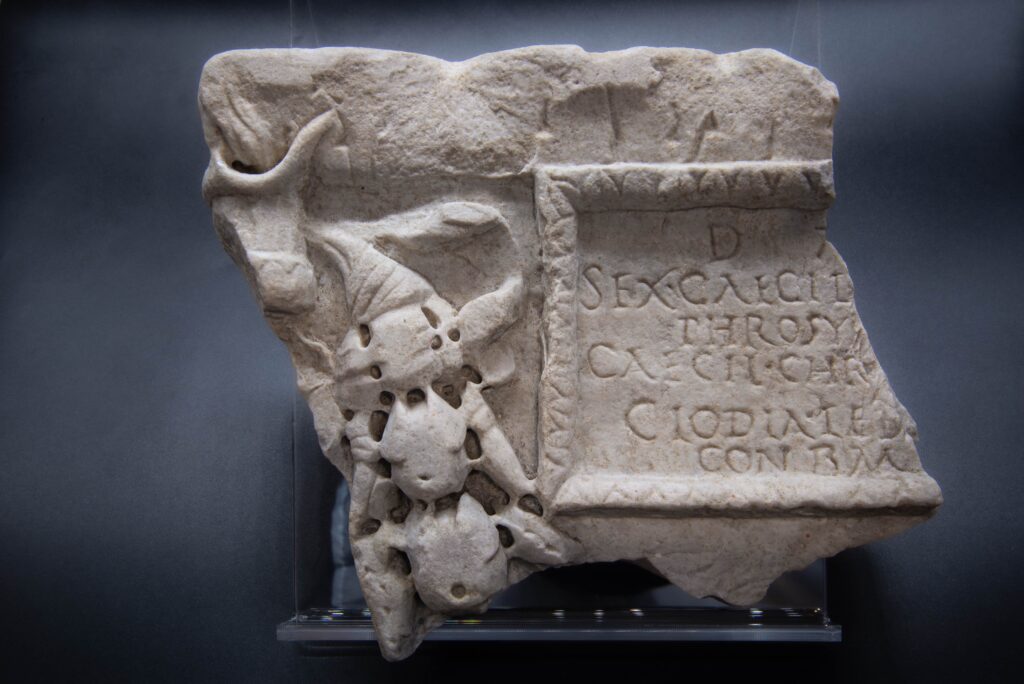
The inscription records that the dedication was commissioned by his wife and daughter. This detail is significant. Female commemorative initiatives, well attested in Roman epigraphy, reflect an active role in shaping family memory. Clodia Leda and her daughter (whose name can be reconstructed as Chreste, Chrema, Chronia, or Chresis) entrusted the name of the deceased to the permanence of stone.
More than a private gesture, the inscription represents a formal act of remembrance, where personal affection and social representation converge.